Diabetes: Under Surveillance

One of the first steps toward preparing for the pump* is the 72-hour Continuous Glucose Monitoring (CGM). On a Monday, I went to my doctor’s office and a sensor was inserted into my abdomen that would take blood glucose readings every 5-minutes. This data would be downloaded when they removed the sensor on Thursday.

CGM
Not my stomach, BTW

So, for three days, I had a little plastic pod thing attached to me. It only hurt when the needle inserted the cannula (skinny plastic tubing) under my skin. The needle is removed and the pod is taped tightly so the cannula will not be disturbed. I could go swimming, exercise or anything I wanted to do. Within reason they said. Obviously they don’t know me very well, but I would try to behave myself.

At first, having a foreign object on me felt strange and I was super aware of it being there. Once I got home and doing things around the house, I forgot all about it. I didn’t mind it at all. It made no sounds, I felt no vibrations from it. No pain either. The little pod just hung out with me and took its little samples. Which meant no more Christmas cookie nibbling for me. 😦

It reminded me of those science fiction shows about humans with robotic RoboGma parts. You know, like the bionic woman, but it my case it was closer to Robo Grandma.

I can hear Rod Serling now…   ‘A woman is implanted with a surveillance device – a ‘bug’ if you will, to track the glucose in her bloodstream and send it to her doctor. What she does not know, is that it sends other data to the NSA.’

~~~~~~~~~~~~~~~~~~~~~~***~~~~~~~~~~~~~~~~~~~~~~

* Not all health providers have the same rules and requirements, so this procedure may not be required.

.
photo credit: achadwick

photo credit: pasukaru76 via photopin cc
It’s Here! It’s Here!

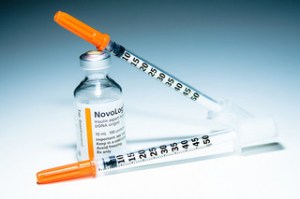
My insulin pump arrived today – Yeah!   NovologSyringe

I haven’t opened the large box yet, because I’m 40% excited and 60% terrified. This pump thing is a major lifestyle change and y’all know how much I love change! Even good changes, like getting rid of syringes and insulin pens.

Even though I am curious, I don’t want to get ahead of the game plan I’m working with the Certified Diabetes Educators (CDE’s). They are committed to preparing me with the knowledge I need to have and records I need to keep in order for the doctor (an endocrinologist) to accurately program the pump to work with my ratios, etc.

I, actually we (because I made hubby come with me), had a class this morning in Modesto. A 2-hour drive there and back for a 1-hour appointment. I have counted carbs for years, but this class was about insulin pump carb counting – a very detailed and meticulous way to account for every single carb to be ingested.

Carb counting has always been important for diabetics. If you are using an insulin pump that acts like a pancreas, slowly dispensing a constant dose of insulin over time and it will give you evenly spaced out insulin to help your body absorb the carbs you eat at meal time.

The next class is Dec 30th. The CDE will review my logs and give me a test.  I have homework to do before the class. HOMEWORK!? I’m so happy it is not calculus.

So, I will be reading materials, looking up carbs, fibers and fats, doing math and writing everything I do on a big chart, during the holidays. I hope your holidays are a bit more festive 🙂

I sure hope I have time to blog in between all this crap stuff…

!LIGHTS_

A Merry Christmas to All and a Happy New Year!

Diabetes: Rumors VS. Truth

Type I Diabetes runs in my family, so I grew up in a ‘diabetic friendly environment’. Occasionally, I forget that the lucky non-diabetic people have limited information about how we (people with diabetes) live with the disease and it’s consequences.

So… before I begin to write posts about my adventures with starting on insulin pump therapy, I want y’all to have  some background knowledge and dispel any ridiculous incorrect information you may have heard about the disease (or its victims).

Diabetics cannot have any sugar or they will go into a coma. Although it is true that we need to severely limit our intake of sugar, eating sugar will not make us fall over into a deep sleep.

Coma happens to diabetics that are not being treated or have not been diagnosed. An undiagnosed diabetic who does not eat sugar or a lot of carbohydrates, can still have drastically high blood glucose levels, and over time, will eventually become ill enough to be comatose.

If you eat too much sugar you will get diabetes. Totally not true. Ever.

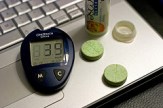
DiabetesTesting
Severe low blood sugar

High blood sugar is more dangerous than low blood sugar.  False. Low blood sugar (under 60 mg/dL) can  cause sweaty clamminess, shaking, irritability, or violence. Severe low blood sugar (under 40 mg/dL) can cause  seizures, hallucinations, brain damage and death. High blood sugar over time will cause nasty complications, but not the immediate danger low blood sugar does.

Taking good care of yourself can make your diabetes go away. Totally not true. Ever. Diabetes is a disease that causes your pancreas to stop producing the insulin that helps your body break down sugar.

While it is true that a better diet and more exercise will help your body regulate glucose levels, your pancreas will not regenerate its way back to health. (Dammit!)

Diabetics have to eat meals based on recipes in ‘diabetic cookbooks’. No, we don’t!  We can eat any foods ‘normal’ people eat. We only have to ‘do the math’ to adjust our insulin dose and watch portions of carbs and fat.

People always ask me “can you eat this, or have that?” Yes, I can have a piece of that wedding cake. Or fruit salad. Or Christmas cookie. But I shouldn’t have any more than that. It’s a matter of proportion and choice.

Friends worry they will offer me something “bad for me” or “tempt me” into eating things I can’t have by eating them in front of me. STOP worrying! Prepare whatever menu you would like. I know what I should and shouldn’t eat. It is my responsibility – not yours.

I hope that by answering the questions that I am asked the most, will answer questions you may have about diabetes. If you have questions not answered here, please submit your question below. You may also submit diabetes related subject you would like to know more about  🙂

← Back

Thank you for your response. ✨

.

.

photo credit: DeathByBokeh via photopin cc